Are Veneers Really Worth the Long-Term Cost Compared to Braces?
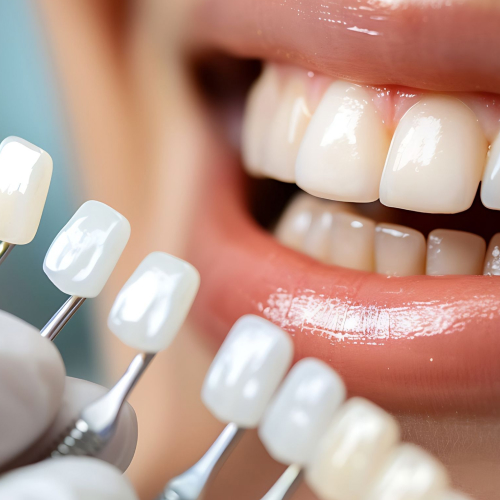
Comparing veneers vs braces cost? Discover which smile makeover fits your budget and goals. Call Long Beach Family Dentist today to book your consultation!
Read More
A root canal rarely travels alone — the crown and a little-known core buildup procedure complete the full treatment, and insurance often covers less than patients expect. Understanding the three-part anatomy of treatment and how to time your care across calendar years can meaningfully maximize your available benefits.
For Long Beach patients, most people plan for two things: the root canal itself and the crown on top. What catches patients off guard is the procedure sitting between them — the core buildup, billed under CDT Code D2950.
Here's how the full treatment actually breaks down:
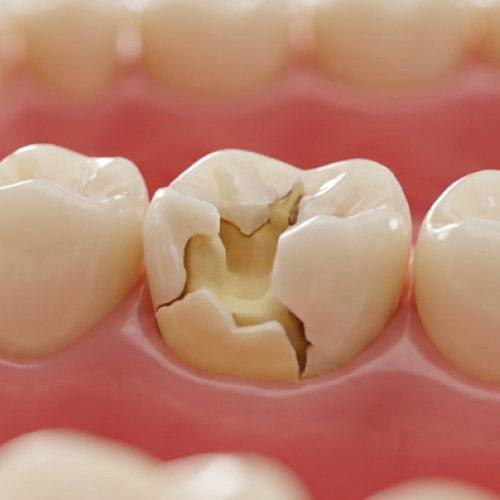
The core buildup is clinically necessary when a tooth lacks sufficient natural structure to retain a crown after the root canal. Yet according to the ADA Council on Dental Benefit Programs, many insurance plans routinely deny or downgrade this charge, sometimes bundling it with the crown as if it were a single procedure.
Bundling — defined by the ADA as "the systematic combining of distinct dental procedures by third-party payers that results in a reduced benefit for the patient/beneficiary" — is explicitly against ADA policy, yet it remains common.
What to do: Before treatment begins, request a pre-treatment estimate that itemizes all three procedure codes. If your estimate only shows two line items, ask your dental team specifically whether a core buildup will be needed and how your plan handles D2950. Catching this early prevents a surprise explanation of benefits after the work is complete.
Standard dental insurance plans cap annual payouts at a set maximum and then pay only a portion of major procedures like root canals and crowns. As the ADA notes, many patients mistakenly expect dental coverage to function like medical insurance, when it actually works more like a discount program with strict annual ceilings.
A combined root canal and crown frequently exceeds a single year's available benefit. If that happens mid-year, everything beyond the cap comes entirely out of pocket.
The calendar-year split strategy:
If your dentist determines you need both procedures and your remaining annual benefit is limited, ask about staging the treatment:
This approach requires coordination with your dental team and depends on your specific plan's rules, but it's a legitimate and commonly used strategy. Ask for a pre-authorization on both phases so you understand exactly what each benefit year will contribute before you commit to the timeline.
Not every root canal is performed by a general dentist. Molar teeth have more canals, more curvature, and greater complexity. When anatomy or prior treatment history makes a case more involved, your general dentist may refer you to an endodontist — a specialist focused specifically on root canal therapy.
According to WebMD, an endodontist is a dentist who specializes in the causes, diagnosis, prevention, and treatment of diseases and injuries of dental pulp. Endodontists are frequently out of network even when your general dentist is in network.
This creates a balance-billing risk: your plan pays its out-of-network rate, and you owe the difference — a gap that can be significant for molar cases.
What to ask before accepting a referral:
Anterior (front) teeth typically have one canal and are more straightforward; bicuspids have one or two; molars can have three or four. Tooth type is the primary driver of which provider performs the procedure and, by extension, what your coverage calculation looks like.
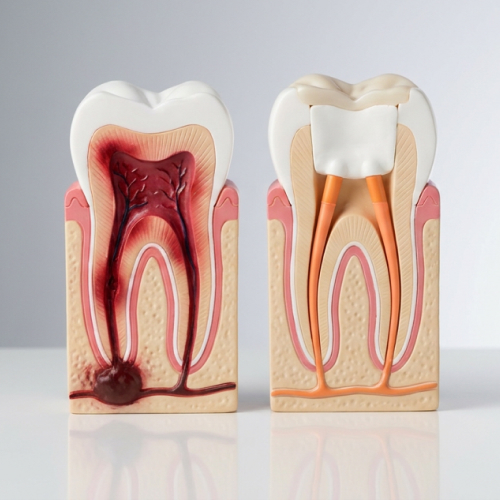
Understanding the treatment makes more sense when you understand what you're protecting. Research from the Regenstrief Institute found that the median survival time of a tooth after a root canal is approximately 11 years. However, teeth that receive both a cavity filling and a crown after the root canal last roughly 20 years — nearly double the outcome of teeth that receive no restoration at all.
A systematic review published in the NCBI Bookshelf also found that endodontically treated teeth compared favorably to dental implants-supported single crowns and fixed partial dentures in long-term survival, and that extraction without replacement carried inferior psychosocial outcomes.
The takeaway: skipping the crown often shortens the tooth's functional life substantially — meaning you may end up facing greater complications over time. The core buildup, crown, and proper follow-up care aren't optional extras; they're the part of the treatment that makes the root canal worth doing.
Insurance questions are genuinely complex, and the answers vary by plan, tooth type, provider network, and timing. If you're navigating a root canal and crown in the Long Beach area and want to understand your actual coverage picture before treatment begins, Long Beach Family Dentist can review your benefits, walk through pre-treatment estimates, and help you plan the timing that works best for your coverage. Reach out to schedule a cleaning and exam consultation — knowing the full picture upfront is always the right first step.
This article is for informational purposes only and does not constitute dental or financial advice. Treatment needs and insurance coverage vary by individual. Consult a licensed dental provider for guidance specific to your situation.
Fresh news from the dental world

Mon 8AM - 5PM
Tue 8AM - 5PM
Wed-Thu 8AM - 5PM
Fri 8AM - 5PM
Sat 9AM - 3PM
Sun Closed
Check out what our patients are saying in Long Beach, CA...


“My favorite dentist...”
The service here is amazing and they make you feel comfortable. I'm one of those people that hates to go to the dentist and the dentists that I went to in the past were not that great with service. Overall I found my favorite dentist service now at Long Beach Family Dentist.

“Clean and friendly...”
Very clean and friendly crew. I really enjoyed myself.

“A positive experience...”
Very clean and organized office! Entire staff was pleasant and friendly, and seems interested in ensuring I had a positive experience. Will definitely return! Affordable rates.

“Answers any questions...”
I been a patient here for over twelve years. Andrea greeted me and got my folder set up. Toni is very friendly and answers any questions you have promptly, when I always come in she greets you with a smile and makes your appointment enjoyable. Today Jovani and Dr. Joan made this experience great. I recommend this dentist for new patients.
“My favorite dentist...”
The service here is amazing and they make you feel comfortable. I'm one of those people that hates to go to the dentist and the dentists that I went to in the past were not that great with service. Overall I found my favorite dentist service now at Long Beach Family Dentist.
“Clean and friendly...”
Very clean and friendly crew. I really enjoyed myself.
Check out our accreditations, sources, and relationships in the wide world of dentistry...











Check us out and follow our Long Beach, CA practice on social media...